Saturday, July 18, 2015

Movie Review - Princess Mononoke (Blu-Ray)


Princess Mononoke is one of Hayao Miyazaki's most popular and enduring feature films.  I hear it discussed in anime enthusiast circles, I see it shown during conventions, and it's usually a staple during any Miyazaki movie night.  It's an epic spanning feudal Japan, when Samurai fought for hire or a single master, when iron was highly coveted, and rifles a new invention.  It pits man against gods: wolves and boars and apes, and the mysterious Forest Spirit.  Its soundtrack sweeps you into a world of beauty and battle and fierce women, and one man who wanted to find peace.

Ashitaka is one of the last of the Emishi, a people driven to near extinction by the Japanese emperor, known for their unity with the forest, their uncanny skill with the bow, and for riding giant red elk instead of horses.  As Ashitaka returns to his village one day, a monster attacks, nearly killing three young girls, including Ashitaka's sister.  He fires an arrow into the monster's eye, and it retaliates, leaving him with an ugly, fatal scar.  As it dies, the monster transforms into a giant boar, a god, possessed by fear and rage that turned it into a raving demon.  The village wise woman sends Ashitaka west to find the forest from which the boar came, hopefully to discover a way to save his life, but more importantly, to "see with eyes unclouded."

As Ashitaka travels, the scar proves to be almost a living entity, triggered by battle and blood and making him not just a keen shot with a bow, but a butcher - decapitations, severed limbs, all with a single arrow.  He meets a monk who directs him toward a legendary forest, home to the Great Forest Spirit, rumored to be the god of life and death.

However, Ashitaka is not the only character with a weighty quest.  Bordering this same legendary forest is an ironworks run by the Lady Eboshi, a business-savvy, cunning swordswoman.  She fights the animal gods to claim the iron under the forest trees, and she drives off a neighboring lord who tries to subdue her into giving him the iron for which she labors so hard.  In her ironworks, she employs women from local brothels, giving them honest work and honest husbands from among her riflemen and cattle drivers.  She even houses lepers, treating them as people when others would not.  Lady Eboshi is beloved by her people, and even Ashitaka recognizes her as a formidable leader.
But not all love the Lady Eboshi.  A young girl, a wolf-princess, hates her with all her soul, having vowed to kill her to stop her murder of the animals and trees.  Adopted by a wolf goddess, Mononoke exists solely to defend her mother's forest and slaughter those who threaten its peace.  As Ashitaka approaches the ironworks, he encounters Mononoke and her wolves as he saves two men from drowning along the bank of a flooded river.  She departs with barely a word, and Ashitaka continues through the forest with the two men, guided by the adorable kodoma, and arrives safely at the ironworks. While Ashitaka observes Eboshi and her people, Mononoke attempts an assassination, which Ashitaka foils.  In doing so, however, he is shot near the heart, and Mononoke, apparently in return for her own life, takes him to the island of the Forest Spirit to ask it to heal him.  It does, but the fatal scar remains.

Confounded as to why the Forest Spirit would allow him to live, only to die slowly from the boar's infection, Ashitaka learns the other side of the conflict: the wolves' struggle, the boars' demise, why they fight, why they remain, and why so many different human factions want the forest.  He uncovers a plot to slay the Forest Spirit and bring its head back to the emperor, an atrocity fueled by the rumor that the head will grant eternal life.  Outraged by the hatred and massacre, Ashitaka involves himself in the battle in a desperate attempt to bring peace, and win Mononoke’s heart.

Princess Mononoke was the second Miyazaki film I ever saw (the first being Kiki’s Delivery Service).  Given that my experience with anime at the time was limited, I wasn’t sure what to expect.  I was appropriately unnerved by the transformation of an animal god into a demon of hate, and awestruck at the beauty of the Forest Spirit and his woods.  I felt a conflicted sense of admiration and contempt for Eboshi, and absolute conviction toward Ashitaka and his cause.  Mononoke herself I loved instantly – a warrior child raised by wolves, living in a vast forest, able to speak to animals and spirits and gods.  I pitied her, however, that she was so stubborn as to refuse to understand Ashitaka’s actions.  I suppose one could say it’s because of the difference in their environments – while both were raised in woodlands, and with the ability to commune with the creatures therein, Ashitaka lived in peace, humans and animals partners in their existence, while Mononoke knew nothing but war.
This concept of a human child raised by wolves is well-known.  Rudyard Kipling introduced the world to Mowgli in his epic classic The Jungle Book, which Disney immortalized as a kid’s musical animated feature (leaving out much of the original plot, I might add).  I idolized this idea as a child, and wished I could be raised by a pack of lions or tigers or cougars (I lived in northern California, and I ADORED cats), but I wondered what would prompt a wolf, or any man-hunting creature, to adopt and raise a human child, even figuratively speaking.  Is there some kind of symbolism in it?  A fierce predator is capable of compassion and nurturing and takes an inferior species as its own in an attempt to… improve it?  Protect it?  Or perhaps a more subversive motive – use it against its own kind, a kind of trump card.

This last may be a reason Moro, the wolf goddess, chose to spare the infant Mononoke when her parents tried to use her as a decoy to save their own lives.  Mononoke may have originally been intended as an assassin, able to infiltrate a human settlement where a wolf had no hope of entering, or she could have been a symbol of what man and beast could accomplish together, an icon that everyone but Ashitaka ignored.  He saw what she represented, but no one listened, leading to ruin and slaughter and despair.

Don’t be deterred by the somber themes of the movie, however.  It’s a beautiful work of art.  The animation is superb, the scenes vivid and intricate, and the musical score a delight to hear.  And fear not, it ends on a hopeful note, as all Hayao Miyazaki films do.

Princess Mononoke is a vibrant and thought-provoking story about the industrial revolution and how it destroyed the tenuous harmony between humans and nature.  Miyazaki explores themes like fear and hate, war and sacrifice, life and death, revenge and compassion, all encompassed with brilliant animation and a majestic score.  There’s a reason this film is one of his most popular, and continues to be perhaps his greatest battle epic to date.  I highly recommend it, but not for small children.

Monday, October 20, 2014

The Scooter Story

Scooter is a horse.

He's a beautiful, sweet, gentle brown who LOVES his food.  Bermuda, alfalfa, grain, grain supplements, you name it; he loves the stuff.  He greets me every feeding with an enthusiastic nicker, and sometimes comes trotting from the back of his pen so quickly I worry he'll knock me over.  He never does, though.

I've been a feeder at M2 Sporthorses for about three weeks.  My next-door neighbor owns a horse and stables him at M2, so when an email went out from the owner that she needed a feeder during the week for an hour morning and evening, my neighbor texted me and asked if I would be interested.

While I don't think I quite classify as a "horse person" the way I classify as a "cat person," I still love being around them (so long as they don't step on my toes).  Naturally, I texted back a resounding YES.

While we waited for the barn owner to email back, my neighbor, having worked in the industry for several years, gave me the skinny on the little-known duties of a barn feeder.  " A feeder doesn't just feed the horses their hay and grain," she said.  "They keep an eye on them, watch their behavior, check for obvious discomfort or deviations from normal patterns.  A feeder watches whether a horse is losing or gaining weight, and makes sure this is supposed to happen.  A feeder is the one person that sees a horse most frequently during the day - up to three times, depending on the barn.  You will see the horses even more than their owners, sometimes.  If something bad happens, you will be the one to notice it first."

She gave me the abbreviated lesson on two of the most common and critical situations and how to identify symptoms, and informed me that "simply walking a horse while you call the emergency contact could save the horse's life."

Having this information floating around my brain, I began my duties at M2 with a sense of great responsibility.  Heaven forbid a horse get injured or die on my watch.  I'd be mortified.  No, I'd be devastated.

In my brief time as a feeder, I've noticed that each horse has its unique personality, but they're all INCREDIBLY excited when it comes to food.

So last Friday, when I drove up to Scooter's stall in my Gator and poured his grain and supplements in his pan, and he DIDN'T MOVE, an alarm went off in my head.  Even when I offered the grain to him in my palm, he didn't take it.  Up close, I could see his sides heaving and his nostrils flexing rapidly, and when I tried to get him to move, he stumbled.

Stumbled.

As in he couldn't keep his balance and nearly fell over.

Witnessing a horse fall over when it doesn't want to is a horrible sight.  My riding teacher often said that a horse is a very proud animal, and it doesn't want to embarrass itself.  This is why you give it its head when going downhill.  It can find its way better than you can.

Seeing poor Scooter panting, barely standing, his head drooped, and pawing incessantly at the ground with one hoof, of course I knew something was wrong.  I grabbed my cell and called the guy who trained me (he's a retired equestrian professor).  "Bill, there's something wrong with Scooter..."

Two minutes later, Bill and I were checking Scooter head to hoof, and we found one hind leg swollen three times its normal size.  Unfortunately, we couldn't seen an obvious cause.  Bill sent me off to finish my feeding rounds while he called the owner, and I promised I'd come back and check on Scooter after I was done.

Come time I finished, Bill walked to meet me where I parked the Gator and informed me that it was a possible snake bite, but we wouldn't know until the blood tests came back.  "You're a hero today," he said with a teasing grin.  "And the owner is thankful it happened before you came to feed rather than after." His grin slipped.  "Who knows what you might have found tomorrow morning."  He frowned and crossed his arms.  "That's not something you need to see."

I didn't ask.  I could tell he was thinking of all the times he'd found a horse beyond help laying in its stall.  The helplessness.  The suffering.

He's right.  That's something I don't want to see.

Thank God this time it turned out okay for the horse.  The vet reported the blood work indicates something called cellulitis - basically inflammation of cellulite tissue, an infection; excruciating, and in many cases, life-threatening.  Not for Scooter, though.  "His is mild," the owner told me today.  "His recovery time should be comparatively short.  It's still quite painful for him."

So while I don't exactly have the distinction of saving a horse's life, I do have the satisfaction that I'm taking good care of the creatures in my charge.

Thursday, October 16, 2014

Compassion International Release3 - October 2014

Come make a difference for a child in need.

I've been a sponsor for Compassion International since I was in high school, though it wasn't just me when it started.  As a "project," my class decided to sponsor a child from the Dominican Republic via CI.  Someone who knew someone sponsoring children with them offered the idea.  With about 15 students (give or take per year) in our class, the monthly fee would amount to about a dollar per person, maybe two.  That was a worthy cause for teenagers, yes?  Find a trustworthy organization to which we'd give a measly portion of our allowances, all in an effort to teach us the value of charity.  Alas, even two dollars a month proved too much a commitment for our class, and the support of this little child became the labor of a few.

As time went on, we realized there would be a problem: What do we do with him when we graduate?  Many of us would be running off to college; addresses would change, income would be little to nonexistent, no one would be able to write the boy back (if he chose to write us), and so on.  The obstacles of keeping him as a class project mounted to the point that my close friend and I asked our parents if we could co-sponsor him.  Just the two of us.  "Of course," we reasoned, "we don't want to just throw him back into the sponsor pool.  That's irresponsible, and you're always teaching us about being responsible."  So, our respective folks agreed that any month we couldn't make the donation amount, they'd make up the difference.

Within a year, my friend and I realized that co-sponsoring wasn't working out.  There was too much confusion over getting money to each other, making payments on time (this was before online payments), so I asked my friend if she'd mind if I converted all the information over to me.  She agreed.

Since then, I not only sponsored Aroys de Jesus Martinez from the Dominican Republic until he turned 18, but I continue to work with Compassion International to sponsor Muthu Mari Murugen from India.  She turns 18 next week, which means my sponsorship of her will be over.

I actually hadn't done the math on that until just now.  I think I might cry.

You see, Compassion International doesn't just give kids in impoverished nations food and clothes and means of education.  They work in the entire area to improve living conditions, provide vocation training, even pay for tuition expenses.  They clean the water, they encourage the children's growth as individuals, and aid the child's family.  But most importantly, they teach the Bible to them and help them become all God means them to be.

Of the two sponsor experiences I've had thus far, Muthu has proved to be the more conversational.  Children in the Compassion International program write to their sponsors on a regular basis, and I expect that when they're younger, this task is less than appealing to them.  However, as they get older, some actually WANT to write to their sponsors.  Want to write to you.  To me.

Muthu and I write regularly to each other.  She tells me about her life in India, the festivals she attends, the dances in which she participates, what she's studying in school, what she likes studying versus what is challenging, who her friends are, and her favorite vacation spot.  I tell her about my work and what I read and what I perceive of the world around me.  Muthu speaks and writes English as well as her own native language, so our letters don't have to be translated.  Whenever I get a letter from her, I'm so happy; when she doesn't write for a long time, I get sad.  I miss hearing from her.

And now to my point: Compassion International is doing an initiative for the month of October (RIGHT NOW!).  Sponsors who volunteered to participate (me!) are assigned three children from various parts of the world for whom they are to find sponsors.  Usually, we do this via our churches, maybe our schools, but due to some complications, I'm unable to display my information at church.

So I chose to blog about it. :)

Risda (from Indonesia), Jose (from Guatemala), and Augustin (from Africa) are my assigned children.  They're young and in need of preventative care for illnesses, education, and aid for their families.  For $38 a month, you can provide these things, and more, for Risda, Jose, or Augustin.  It's a significant commitment, I know, but the incredible difference it makes in the life of a child is invaluable.  You'll not only be saving a life, but intersecting that life with yours, praying for them, writing to them, sending them pictures or postcards, developing a bond with that little life as they grow up.

If you want to talk to me about them, feel free to comment or post on my Facebook.  I'd be more than happy to tell you about my experiences as a sponsor.  Or, you can check out their website to learn more about the organization and their ministries, and how you can participate.

Watch a video of one child's reaction when she finds out a sponsor has chosen her.

Wednesday, October 15, 2014

Movie Review: Sleeping Beauty Diamond Edition


Disney’s Sleeping Beauty is one of the most enduring of the Disney classic animated features.  Not only was its use of multi-pane photography a breakthrough in animation technology, but the artistic style and operatic influences were unlike anything Disney had produced at the time.  And, of course, the story itself resonated with audiences everywhere – fairies and witches, a prince and princess, a climactic battle between good and evil.  Little girls all over the world desperately wished to be given gifts of beauty and song and dreams of a prince that actually came true.  It’s no wonder Disney decided to release a Diamond Edition as a sort of companion set to the forthcoming Maleficent release. (Don’t even get me started on Maleficent.  They ruined one of the best Disney villains in history.)

This isn’t the first Blu Ray release of Sleeping Beauty, however.  Back in 2007, Disney issued the Platinum Edition, the first conversion of the audio and video to high definition and chalk full of special features.  Sleeping Beauty has been one of the most popular Disney princess films to date, and everyone has said practically everything about it; so what was I supposed to spend 800 words on for this new edition?
I’ve seen this movie dozens of times in my life.  Each time, I love the music, the quality of artistry, the Sword of Truth piercing through Maleficent’s dragon chest in a victorious moment for the forces of good.  What I never realized was how perfectly they captured Aurora as a teenager.  I mean, she actually believes that “if you dream a thing more than once, it’s sure to come true.”  Literally believes it.  She sings to woodland animals.  She cries at the drop of a hat.  She gets infatuated with a handsome guy within seconds.  And she follows glowing balls of light JUST BECAUSE.  The only thing that’s missing is the rebellious streak.

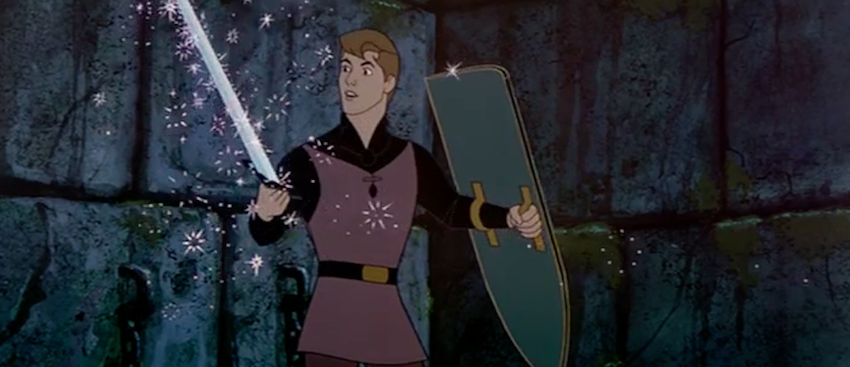
And you know who I never really noticed before?  Prince Philip.  Well, I noticed him, but I didn’t notice his character development.  He was just a pretty face that was supposed to rescue the princess.  But look closer at him.  Sure, when we first meet him, he’s a kid not that interested in an infant.  He does that frowny “ew” face.  The next time we meet him, he’s loafing around the forest with his horse following pretty sounds and wooing musical young women.  Then he flies off to daddy and says he’s going to marry a peasant girl and forget about being king.  He’s pretty teenage-like in his own right despite how much older he is than Aurora.  But what happens when he gets captured?  What happens when he finds out Maleficent’s plan?  He puts on his big-boy pants and saves the day, that’s what he does.  Of course, Flora helps with the details, like busting him out of prison, giving him weapons, and saving him from fate-worse-than-death situations, but hey.  He did the legwork in hacking the forest of thorns and in fighting the dragon.

I kinda think Flora is an unsung hero in this movie.  She’s written as bossy and controlling, but when crisis sets in, you don’t see her flying off the handle or cowering in a corner.  She’s got her ducks in a row and she is READY.  She’s probably the strongest feminine figure in the whole movie – Maleficent has power, yes, but Flora has self-possession, intelligence, leadership, and courage.  When I was a kid, I didn’t like her because she was mean to Merriweather, and I related to Merriweather because she was impish, energetic, and frequently acted on impulse.  (She was also right about using wands, ha!  I loved seeing Flora wrong.)  But if Flora hadn’t been there, the three good fairies would never have taken Aurora into hiding, never raised her to be gentle and kind and (let’s face it) quirky; no one would have put two and two together to figure out Aurora was Philip’s “peasant girl,” bought them the time they needed defeat Maleficent, and most definitely not motivated the other two fairies to get their magical butts up to the Forbidden Mountain to rescue anybody.  There would have been no jail break, no Shield of Virtue and no Sword of Truth, no boulders turned bubbles and arrows turned flowers, no boiling oil turned rainbow, and no last-hurrah as Philip delivered the killing blow.  Even Merriweather using her gift to change the curse from death to sleep was Flora’s idea.  So while she’s brusque and rude and annoyingly obsessed with pink, she’s got the guts to do what it takes to make that happily ever after HAPPEN. *insert finger snap

And Maleficent?  She’s been my favorite Disney villain since forever.  None of the others can compare to her style, her commanding presence, and her blatant acknowledgement of her evilness.  I mean, she ruins Flora’s flowers out of spite; she puts curses on babies because she wasn’t invited to the party; she torments a prince with images of being locked in her dungeon for a hundred years; and she calls on the power of hell to transform into a dragon.  (She gives dragons such a bad name.)  I mean, she can indeed be all bad, as Flora puts it, and she LIKES it that way, making her possibly one of the most dangerous villains ever.  You can’t appeal to a better side with Maleficent because there isn’t one!  I had a debate with some friends of mine about whether villains who are evil because they like being evil are more dangerous that villains who are convinced that what they’re doing is actually right (e.g. Frolo from Hunchback of Notre Dame).  I voted that evil for the sake of evil is more dangerous because the misguided ones still have a chance of being redeemed.  (We never finished that debate, btw).

So, Sleeping Beauty Diamond Edition.  I love this story just as much now as I did when I first saw it as a kid, and it’s definitely worth having in your collection because it’s visually stunning, musically captivating, and emotionally resonating.  What little girl in us doesn’t want to be able to sing like Aurora?  What little boy doesn’t want to slay an evil dragon?  You want this one.  You want it.  Got get it.