Monday, October 6, 2014

Movie Review: Jack and the Cuckoo-Clock Heart


It’s taken several years for me to acclimate to watching foreign films.  I could never quite adjust to the seeming off-timing of words to lip movements.  It’s not just animated foreign films that have this problem; plenty of live-action films have it, too.  My first foray into the genre was with a friend back in high school; alas, I don’t remember which film.  Regardless, when I presented my objections, the friend watching the movie with me declared “That’s just how it is,” and so I decided I hated them all and would stick to American movies.

Then, during college, I got into Anime and the game changed.  I discovered there were two different camps when it came to watching Anime: the Subs camp and the Dubs camp.  Subbers (I call them) are folks who watch only the original foreign language track with English subtitles at the bottom (ergo, “subs”).  They say that the translation is more accurate, and that the story is preserved.  Dubbers, however, watch the same movie or show with the English dubbing track (ergo, “dubs”), meaning someone in America recorded an English version of the dialogue and then overlaid that atop the video.  Proponents of this camp say that paying attention to the action AND subtitles is too much, that the story is just as good as the original, and that a lot of times, they feel the American voice actor is more fitting for the character than the original language actor.

Upon discovering this difference, I immediately gave foreign films another go, this time subscribing to the Subs camp methodology.  My goodness, did it make a difference for me.  I’ll admit, with some surrealist films, keeping track of the visual symbolism and metaphors AND the words at the bottom can be challenging, but in all others, I don’t feel like the dialogue is rushed or ill-timed.  I don’t feel like I lose a piece of the story because the exact translation into English wasn’t enough syllables, or was too many syllables, and therefore the writer changed them so the voice-to-lip synchronization wasn’t so “off.”  And the more I watch films from a particular country, the more I learn bits of the language.

When I first started watching Jack and the Cuckoo-Clock Heart, I could tell right off, from the first few seconds of the film, that this was not an originally English movie.  It showed the classic miss-timing of voice and animation, and it rushed through most lines as though the actors couldn’t quite catch up.  The songs were the most telling, since in the original language most stuff would rhyme, but in the English translation it doesn’t.  I looked for the original French track, but the Setup menu only had English audio and English subtitles.  I was severely disappointed that this would be a strictly American language release.  It was originally a French book, adapted into a French animated feature with French voice actors and French songs, then dubbed in English and released to us.  That doesn’t bother me, so long as the original language is present; since it wasn’t, I felt like the release was incomplete.  I had the same experience with Kiki’s Delivery Service when it first got released on DVD: no Japanese track.  I had to suffer through the movie listening to Kirsten Dunst.  Remembering that, I got to the end of Jack and the Cuckoo-Clock Heart all riled up and ready to give a piece of my mind on the subject… and then I realized I was watching the DVD, not the Blu Ray! *shameface.  Sufficiently mortified, I popped in the CORRECT disc and happily discovered the French track with English subtitles.

Jack and the Cuckoo-Clock Heart is exquisitely animated, beautifully surreal, and probably chalk full of symbolism I didn’t detect because I didn’t grow up in the French culture (I have that sense a lot while watching Anime, too).  The story starts in Edinburgh, England, during the coldest day of the year, as a young mother trudges through the snow to reach a sequestered house on a cliff, wherein a “witch” resides.  She’s definitely different than the rest of Edinburgh: rather scientific, with a touch of the supernatural, and quite adept at mechanical reparations.  She’s like a magical Steampunk mid-wife healer, really.  This “witch,” Madeleine (Marie Vincent and Emily Loizeau, French version; Barbara Scaff, English version), delivers a baby boy whose heart is frozen solid.  She quickly removes the frozen heart and inserts a cuckoo-clock in its place, saving the infant’s life.  “However,” Madeleine, tells the new mother, “there are three rules he must never break: he must never touch the hands of the clock; he must master his anger; he must never, ever fall in love.” Whether these rules seem impossible to enforce, or the thought of having a son with a mechanical heart proves too much, the new mother leaves in the middle of the night, saying that the mid-wife would make a better mother than she.  All seems well for ten years, until Madeleine takes Jack (Mathias Malzieu, French version; Orlando Seale, English version) out to explore the town, and he meets Miss Acacia (Olivia Ruiz, French version; Samantha Barks, English version), a young street performer with a bewitching voice but horrible vision.  Jack nearly dies after this encounter, and Madeleine once again warns him of the three rules he must always observe.  “Your heart cannot handle the burden of such emotions,” she lectures him.  Undeterred, Jack discovers that Miss Acacia went to school in town, and follows in her footsteps, only to come face-to-face with another Acacia admirer – Joe (Grand Corps Malade, French version; Harry Sadeghi, English version), the school bully.  Jack endures four years of torture from Joe, until he finds that Miss Acacia is actually living in a country called Andalusia, somewhere near Spain.  After an accident that renders Joe blind in one eye, Jack flees Edinburgh and happens to meet a French would-be film-maker named Méliès (Jean Rochefort, French version; Stephane Cornicard, English version), also adept at repairing clocks.  The two head to Andalusia together to find Acacia and to win her heart for Jack.


To quote the text on the back of the Blu-ray case, “Jack and the Cuckoo-Clock Heart is a fantastical, wildly inventive tale of love and heartbreak – by turns poignant and funny – in which Jack finally learns the great joys, and ultimately the greater costs, of owning a fully formed heart.”  This is absolutely true, but also misleading.  The story is primarily one of what Jack suffers to find and be with his love, Miss Acacia, but it also deals with themes like courage, sacrifice, abuse, standing up for oneself, and what people endure when they’re perceived as different.  I also found it interesting that the author includes a brief but telling scene from Joe’s point of view.  If you pause for a moment and think about it, everyone views themselves as the protagonists of their life story.  In Joe’s case, he’s the king of the schoolyard, ensuring order and security by exercising fear-motivated control, protecting his Acacia from a strange, unpredictable, and violent mechanical-operated boy.  Of course, conversely, Jack sees Joe’s fate as one he deserves for tormenting those weaker than himself.   
The film is visually stimulating, from the unique animation style to the surrealistically influence narrative, moving from reality to dream with seamless transition.  Songs are an especially good example of how Jack’s inner life switches between the two with startling continuity.  Moons swallow flying trains, a soul greets someone with a kiss, people float on air when speaking of love; there’s even a bizarre and seemingly pointless encounter with Jack the Ripper.  (Given Jack’s active imagination, Jack the Ripper could be Jack’s perception of the world outside his home, or it could be his perception of an alternate self, given what happened to make him leave Edinburgh.)  Perhaps one of the most emotional scenes for me in this movie is at the end, when death is portrayed as simply the freedom from time – all the world stops, and the dead can climb snowflakes to heaven.

While Jack and Joe seem pretty straightforward characters, Miss Acacia was not.  I admired her for her frankness in telling Jack she was in love with someone else and that “embarking on an adventure” with him would be “dishonest.”  Too often we have female characters that are easily swayed by the immediate feelings of someone close by.  Acacia remains steadfast in this until Jack reveals who he is, at which point we see that they could potentially be very happy.  Of course, Joe then rolls back into the picture and tells his version of the same story (which we all know is skewed to steal Acacia from Jack).  Here’s my dilemma: how often have we, in reality, been madly infatuated with someone, only to have our assumptions about that person brought to a grinding halt as soon as there’s even a smidgeon of violent element?  Joe uses this hesitation to his advantage, showing Acacia the “vicious” side of Jack when Jack is simply defending himself.  Unfortunately, Acacia buys right into it.  I’m not saying it isn’t wise to rethink one’s attachment to a person if that person starts showing abusive tendencies.  But I am saying it would behoove us to observe and conclude for ourselves if such an accusation is true.  I’ve been on both the giving and the receiving end of false accusations.  Many a life can be ruined by careless words.

There’s so many different layers to Jack and the Cuckoo-Clock Heart.  It would probably take several watches to pick up on all the nuances.  As end credits rolled, I sat there listening to the music, contemplative of the themes the author chose to grapple.  It makes me want to read the book.  As with most adaptations, many things are left out or changed for the sake of cinematic story-telling; but in this case, we ALSO have a difference in language.  I feel there is so much more to this story than the English can portray, which is why I’m so glad I was mistaken about the lack of French audio track.  This film is certainly worth a watch, given the beauty of the world Mathias Malzieu created in the novel and the screenplay.  Surrealism and symbolism aren’t everyone’s cup of tea, so if you like it after first view, definitely add it to your collection.

Wednesday, October 1, 2014

Movie Review: Gone with the Wind 75th Anniversary Collector's Edition


Beware, spoilers ahead.

Fact: Gone with the Wind won nine Academy Awards in 1940, including Best Actress in a Leading Role (Vivien Leigh as Scarlett O’Hara), Best Actress in a Supporting Role (Hattie McDaniel as Mammy), Best Director (Victor Fleming), and Best Picture.  Fact: Gone with the Wind was nominated for an additional five Academy Awards, including Best Actor in a Supporting Role (Clark Gable as Rhett Butler), Best Actress in a Supporting Role (Olivia de Havilland as Melanie Hamilton), and Best Music, Original Score (Max Steiner).  Fact: Gone with the Wind won the 1989 People’s Choice Award for Favorite All-Time Motion Picture.  Fact: Gone with the Wind is still one of the most celebrated classic films in the history of the industry.  The portrayal of Civil War South, the costume design, and the technical achievements in colorization and use of coordinated equipment, to this day, still affect filmmaking, fashion, and literature, and that’s not the half of its influence!
But why?  Sure, I’ll give the special effects, set, location, costuming, film editing, music, et cetera, kudos to the sky, but the story itself is so depressing.  I’d never seen it before this release.  I’d heard about it plenty, though.  My mother warned me that I’d get annoyed with Scarlett O’Hara’s voice; my friends in college raved about the romance and epic quality of the film; Scarlett herself was discussed at length as either the most cold-hearted, mercenary human on the planet, or the epitome of a driven, clever, shrewd businesswoman. But no one ever told me that Rhett Butler’s famous line, “Frankly, my dear, I don’t give a damn,” was delivered at the END of the film.  I always thought part of the movie was convincing him to give a damn.
Mammy and Scarlett
Yet when I watched Gone with the Wind yesterday, what struck me most was not the romance, not the glorious plantations, not the horror and devastation of war, and not the grand scope of the story.  It was Scarlett herself, her interactions with all the people around her, as a tragic figure in true Shakespearean form.  All Shakespeare’s tragic protagonists start at a height and gradually fall, or get torn down, to depths they didn’t know they could plunge.  Lear was the king of Britain, but when he gave his kingdom to his daughters, they stripped him of his entourage, his dignity, and his sanity.  MacBeth was the favorite of a Danish king, but a prophecy and an ambitious wife enticed him to murder.  Titus Andronicus was the mightiest general of the Roman army, but he chose the wrong successor as emperor, and a prisoner queen took revenge on him and his family, even so far as to make him cut off his own hand.  Hamlet lost friends, family, and his lover.  Othello strangled the woman he loved.  All of these, and practically every other principle character, end up killed by homicide or suicide.  While Scarlett O’Hara doesn’t meet so grisly a fate, she does plummet from majesty to poverty, and then rises from starving waif to wealthy businesswoman only to plummet again, having practically everything stripped from her – her first husband, her home, her family, and her innocence all in the first act, and then her second husband, her friends, her reputation, her unborn child, her daughter, and finally, her third husband, Rhett, in the second act. 
Rhett Butler and Scarlett O'Hara Butler
I feel both repulsed by and profoundly sorry for Scarlett.  She seems to expect that people will forgive her no matter what she does.  She treats emotional entanglement with a married man as something romantic and talks of running away with him as though it’s acceptable.  She coerces, cajoles, manipulates, lies, cries, complains, and criticizes throughout the entire film, with only a few moments revealing her true heart.  I think that’s what made me finally pity her.  After all the fear and pain and misery she endured, physical and emotional, she and Rhett constantly allowed their pride to forbid forgiveness.  There’s a moment when Scarlett wakes up in the morning after a night of passion with her husband Rhett, and she’s actually HAPPY about it, but when he comes in, he doesn’t seem to see the light in her eyes and the glow in her face; he sarcastically apologizes for his drunkenness and informs her that he’s leaving for London and taking their daughter with him.  Immediately, the wall of self-preservation comes up to blot out her smile and her laugh.  There’s another moment, when Rhett and the daughter return from London, where Scarlett shows such relief and joy at his return, but he makes a snide comment and the wall is thrown back up.  Conversely, on Rhett’s side, when Scarlett has an accident and miscarries, she grows deliriously ill, and he worries and worries over her, hoping she’ll call for him, but no one ever comes to say she has.  What kills me is that SHE DID CALL; the film shows her tossing and turning and saying his name, but no one actually goes to get him.  I think that may have pissed me off most.  So much of their marital anguish and misunderstanding could have been avoided if one of them actually showed genuine compassion for the other despite his sarcasm or her dramatics.
Ashley Wilks and Scarlett O'Hara
Rhett is also a complex character.  When we first meet him at Twelve Oaks (the Wilks' plantation), he gives off a creepy, greasy, predator-like vibe.  He witnesses the exchange between Scarlett and Ashley and finds it funny.  He pursues Scarlett as soon as she's first widowed, making a spectacle of her (though she quite enjoys it).  He's mercenary and sarcastic and unscrupulous.  When the war reaches Atlanta, he demonstrates courage and sacrifice and finally confesses that he loves Scarlett, though we know from his own admission that he's "not a marrying man."  Later, he tries to take her as his mistress, but she won't have it.  When she's widowed a second time, he doesn't waste time actually marrying her even though he knows she's still madly in love with Ashley.  When he becomes a father, though, I felt like all his protective pretenses fell away and the audience could see who he truly was - an insightful, intelligent businessman who loves to spoil the women in his life.  I disliked him intensely at the beginning because of his flippancy and his disrespect, but ended up wanting him to be happy.
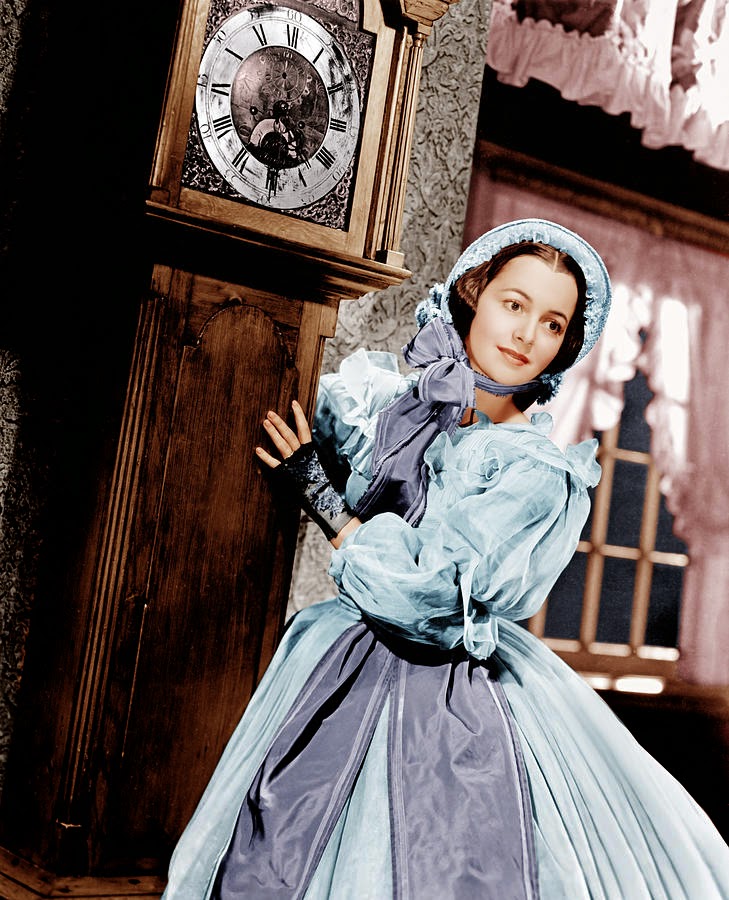
Olivia de Havilland as Melanie Hamilton
Frankly, there were only two characters in the whole movie I liked.  The first was Melanie Hamilton, later Melanie Wilks, the woman who marries Ashley Wilks (Leslie Howard), the object of Scarlett’s long-suffering adoration.  She’s the only truly kind person in the entire South, as far as I can tell.  She constantly thinks the best of everyone; treats slaves, prostitutes, socialites, and plantation owners with equal respect; and defends those she loves from slander, even if the slander is true.  I adored her every second she appeared on screen.  Her compassion, gentleness, and wisdom were the perfect foil for Scarlett’s selfishness, conceit, and abuse of others.  I cried hardest when she died.  The second character I liked was Mammy, Scarlett’s sort-of nanny – a house slave.  She’d lived with the O’Hara’s since before Scarlett was born, and when Mr. and Mrs. O’Hara died, she went with Scarlett and her second husband (whom she stole from her sister) to Atlanta and stayed with her even after the second husband died and Scarlett married Rhett.  She always gave Scarlett the piece of her mind she needed to hear, and had no qualms about challenging her on her behavior.  But she was also a mother to Scarlett, a nurse when she fell ill, a protector, and a guardian.
While I dislike Scarlett, I LOATHE Prissy, one of the house slaves from Atlanta.  Her voice is as high-pitched as a child's scream; she blatantly deceives Scarlett about her qualifications; she works at a snail's pace even though circumstances demand urgency; and then on top of everything else, after Scarlett takes charge and delivers Melanie's baby practically by herself, Prissy goes to fetch Rhett to help them escape the city and has the gall to LIE and say SHE delivered the baby and "Scarlett helped a little."  I wanted her to die so much.  At least we only have to put up with her until they get back to Tara (the O'Hara plantation).  She fades into the background and we never have to listen to her again. 
While Gone with the Wind is indeed an impressive cinematographic achievement, especially regarding technical innovation and costume design, the plot and character development are certainly not cheerful.  There are understated and meaningful interactions among the characters, even dexterous commentaries on human morality, survival, and loyalty, but I felt an intense sense of loss as the exit music played.  This movie broke my heart.  Scarlett O’Hara will forever be to me one of the most tragic figures in cinematic history; honestly, I don’t see how she’d ever get Rhett back after all she’d done.  Words would be meaningless to him.  How did he put it? “You think that by saying, ‘I’m sorry,’ all past can be corrected.”  While I’m not a fan of tragedies, Gone with the Wind is still an exquisite movie – the subtlety, the nuance, the gradual accumulation of tension is so profound that at the end, when everything falls to pieces, I wept for Scarlett, not because I liked her, but because I pitied her so much, and pitied the people whose lives she ruined.  It is a masterpiece, and while it won’t be something you’ll often be in the mood to watch, it’s still worth including in your collection.

Monday, September 29, 2014

Film Review: The Audrey Hepburn Collection on Blu


Audrey Hepburn has always held a kind of magic for me.  She’s one of the classic actresses that tended to play herself in all her roles, but since I love the person she was, I find nothing to criticize.  She always had a disarming charm that made me wish I could be like her.  In movies like Sabrina and Breakfast at Tiffany’s and Charade, she possessed a delightful confidence and unassuming candidness rarely seen in contemporary films.  I envy her these traits.
Warner Brothers releases the Audrey Hepburn Collection on Blu Ray, containing audio and visual transfers of three of Hepbun’s most iconic films: Sabrina, Funny Face, and Breakfast at Tiffany’s.

Sabrina 
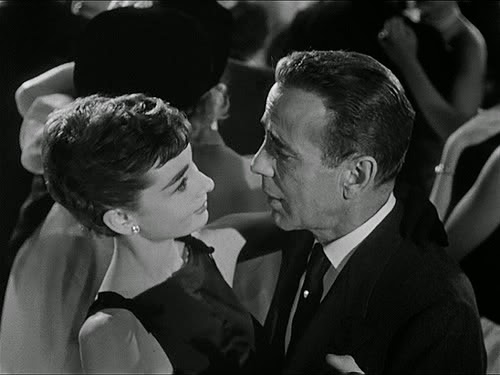
Sabrina is the story of a chauffeur’s daughter (Audrey Hepburn) obsessed with the youngest son of her father’s employer. She gets shipped off to a quality cooking school in Paris, where her father hopes she will not only learn skills to help her gain employment, but also that she will get over David Larabee (William Holden), a notorious playboy.
Sabrina, however, returns a transformed creature.  No longer awkward and girlish, she steals David’s heart with her sophistication and charm, right out from under his workaholic brother’s nose.  Afraid that his plans to marry off David to seal a twenty million dollar merger will go awry, Linus Larabee (Humphrey Bogart) attempts to dissuade, then distract Sabrina from her heart’s desire.  In the process, however, he discovers he has a heart as well as a brain, and Sabrina begins to waver in her certainty of her love for David.
 I saw the Julia Ormond/Harrison Ford Sabrina first, many years ago, and LOVED it, but I had no idea it was a remake until a friend of mine rented the DVD (remember those days?) and brought it over.  I remember watching in and mentally comparing it to its more recent counterpart, and I concluded in the end that the original Linus did not love the original Sabrina.  Why?  Because the way Bogart played him felt more like a calculating charlatan, while Ford’s version clearly transitioned from callous seducer to altruistic suitor.  The change was more obvious, genuine, and above all, believable.  Yet I didn’t understand why until I watched Sabrina again in this collection.
It wasn’t so much the story itself, but rather Bogart’s tendency to act the same precise way with certain lines.  I’ve seen enough of his work between my first viewing of the 1954 Sabrina and now to conjecture that in particular parts where Linus tells Sabrina some sad story of his past, it’s not that Linus is making it up to gain her sympathy like I first thought; it’s the way Bogart delivers, “Oh, yeah,” as if being recalled to something he mentioned previously is somehow an unexpected surprise.
Don't get me wrong.  I love Bogart.  I love him in Casablanca, and I love him in To Have and Have Not, and I love him in this.  I suppose my bias toward Harrison Ford is partially rooted in my love for Han Solo, and partially rooted in my dislike of the generally accepted condescension toward women during Bogart's era.
Hepburn, however, is far superior to Julia Ormond in her performance of Sabrina Fairchild.  While Ormond held her own acting with Harrison Ford and Greg Kinnear and had her own characterization of Sabrina, she didn’t have the same illumination in her face, nor the same confident grace for which Hepburn is renowned.  And, of course, Hepburn added to all this her singing a lovely little French ballad, La Via En Rose.

Funny Face
This isn’t your normal opposites-attract love story.  When a fashion magazine executive Maggie Prescott (Kay Thompson) and her head photographer Dick Avery (Fred Astaire) barge into a bookstore without permission to use it for a photo shoot, bookseller Jo Stockton (Audrey Hepburn) catches their attention with both her vocal assertiveness and unique face.  When the same magazine executive decides the world needs a representative of the “ideal woman,” the same old models just won’t do, and she decides that Jo is different enough to make it work.  Jo, however, has no desire to model, and it takes an appeal from Dick to lure her to Paris to both model for their magazine and meet her favorite living philosopher. 
Funny Face is one of my least favorite Audrey Hepburn movie.  It follows the same general direction of all musicals – songs and dances are stuffed into scenes wherever possible, regardless as to whether they ought to fit there.  I think perhaps sometimes a composer is so intent on squeezing a song into a scene that they sacrifice quality and character believability. 
For example, the modern dance number in the Paris café – was there a revealing character point that needed to be mad?  No.  We already know Jo is independent, willful, and naive.  The dance does nothing to augment or clarify that.  It might be construed as demonstrating the “accepting” or perhaps “indifferent” mindset of the café patrons, as they studiously ignore Joe’s antics no matter what she does.  However, had the film would not have suffered in the slightest if the number were cut.
Also, the song about what reporters would ask Jo as the representative of the ideal woman.  In no other scene do reporters ask anything of Jo, so why it is there? Again, we know the characters’ traits and history from previous scenes, so there’s no development needed, and the song doesn’t forward the plot or reveal anything necessary to the climax or resolution.  It might have been added to help show what the fashion industry tries to shove down women’s throats about how to “be lovely;” unrealistic standards, all of them, since loveliness as defined by this song is possessing an endless supply of happiness, charm, know-how, jolliness, and cheeriness.  Ridiculous.  However, despite this clarification, the song has no useful function.  Thus, the film, again, would not have suffered by its absence.
The story, however, can be viewed as rather compelling.  It’s a tongue-in-cheek battle between the superficially beautiful and the self-righteously intelligent.  The two war against each other, saying their way is the single definition of value, the true way to happiness.  Each detests the other for their lack of understanding and acceptance, for their disrespect and mockery.  But the representatives of these worlds, Dick and Jo, somehow manage to connect, appreciate, and eventually love each other.  Dick is the only one in the fashion world that treats Jo with any modicum of respect, and Jo is much more than the usual glamorous-yet-vapid models with whom Dick usually works.  Unfortunately, they still step on each other’s toes in surprisingly realistic dynamics: Jo forgets an appointment in her excitement at spending time with fellow philosophers; Dick reacts badly when confronted with jealousy; Jo’s naiveté about men’s motivations put her in a dangerous situation; and Dick insults Jo’s beliefs in a fit of frustration.  They apologize, forgive, miscommunicate, resonate, and, ironically, manage to overcome their differences by exercising the one trait Jo prizes so highly, yet fails at applying: empathy.  Moral of the story: It’s never either/or, but a balance of both/and.
Rant on the video quality: There are two scenes where the director chose to make artistic changes, the most annoying being glaring over-exposure.  The edges of everything are softened, and anything white catches the light so intensely it gives the picture a hazy shimmer.  It’s hard to watch despite the lovely location and pretty song, so much so that it gave me a mild headache.  All other scenes noticeably lack this little flare, and are the better for it.

Breakfast at Tiffany’s 
Breakfast at Tiffany’s is one of the most celebrated of Audrey Hepburn’s films.  She plays Holly Golightly, the carefree ingénue searching New York for her perfect dream millionaire.  One morning, Paul Varjack (George Peppard), a disillusioned young writer, moves into her building at the behest of his “patroness,” and he gets caught up in Holly’s hectic yet captivating lifestyle.  She calls him Fred because he resembles her brother, and the two of them form an affectionate bond, one that survives personal drama, drunken insults, and romantic entanglements.
I feel sorry for Holly Golightly.  She spends the whole movie not knowing who she is or what she wants, scared to pieces that she’ll be trapped in a life she hates, all while pretending to be glamorously eccentric.  Charming she is, for sure, but even within the first ten minutes, we see her admiring wealth, fleeing aggressive suitors, manipulating men, and confessing to have moments of inexplicable terror – what she calls “the made reds.”  But then, she is also so darling and innocent and child-like all at the same time you can’t help but enjoy her when she’s lively, or feel protective when she’s scared or grieving.  I think that’s Holly’s universal appeal, the timeless draw of Breakfast at Tiffany’s:  We see pieces of ourselves in Holly, and Hepburn has such a way of taking any character she plays and making her endearing.
Paul is also an interesting character.  I’ve seen Breakfast at Tiffany’s three times, but only during this last did I pay attention to his character story.  I always felt him too forgiving of Holly, but there are aspects of him I didn’t notice before – how he people watches instead of interacting, his constant “saving” of Holly (though she often forces it on him), his acceptance of being “sponsored” by a married woman, and his resentment at the lack of success of his first book.  He transitions from a passive-aggressive protector to an active rescuer to a demanding lover, ultimately refusing to accept Holly’s stubborn pursuit of easy wealth and challenging her on her notions that everyone else is seeking to put her in a cage – she’s already in one of her own devising. 

I enjoyed my little foray into Audrey Hepburn’s most celebrated works.  She’s spunky, affectionate, and guileless, with a lovely singing voice and long, dramatic eyelashes.  From the glamorous Sabrina to the unconventional Jo to the whimsical Holly, Hepburn is always a delight.

Okay, fine, I'll say it - she's damn adorable. :)


Friday, September 26, 2014

Life Lessons in RPG's

Nerd time.

I'm playing Dragon Age: Origins again (sporadically, but it still counts).  This is my fourth campaign - I've played a female elf warrior (actually played twice from one early save point, so I count it as two campaigns), a female human warrior, and now a female human rogue.  I've got a male elf mage waiting in the wings.  I hadn't played as a rogue or mage before, so why not?

Having said that, I'll confess that I play this game, or any RPG, really, multiple times because of the romance options.  Yes, I know; I live vicariously through my video game characters.  This is true for DAO, DA2, all the ME games, and for NWN, KOTOR and KOTOR II.

I never actually finished NWN2....

Point being, I discovered something about myself, and consequently human nature, through my "relationships" in Dragon Age: Origins.

The sincere, awkward guy (read: nice guy) is endearing, especially since he comes across as guileless and affectionate, but the suave, seductive guy knows how to appease my vanity, tells me things I want to hear, flatters me, which makes me feel special, and he KNOWS it makes me feel special.

This is not far from real life.  I've met many, many variations of these two types and always have the same debate: choose the nice guy who would be more likely to stick it out for the long haul, even if clumsily, or the guy more likely to turn out an asshole, but wow, does he make my hormones dance RIGHT THIS FREAKING MINUTE.

Three related things about this paradigm:
1. There's always a need, or in the case of games, a pre-programmed requirement, to CHOOSE.
2. In the choosing, we must weigh immediate gratification against future promise.
3. The less sure we are about how the future will turn out, or the more cynical we are about it, the more likely we will choose the immediate gratification, OR we will try to have both.

I found that I've pursued this "both" route EVERY SINGLE TIME.

Any time you play DAO, your character meets Alistair first.  You can gain BUKU approval points from him from your very first post-Ostigar conversation, assuming you exhaust all the options and pick the correct response.
Approval points are the key to triggering a romance, and therefore, a romance with Alistair is both the quickest and the most readily available.
However, after I got the romance achievement with Alistair, I met Zevran, the slutty bad-boy elf who bends everything.  And by everything, I mean EVERYTHING.  Rules, sexuality, himself... ;)  Flirting with him is way more fun that being all awkward-cute with Alistair.  He teases, compliments, makes suggestive comments, even outright offers to stay the night in your tent (after enough approval points).  There's a thrill that comes with such interactions, and it's the same kind of intoxicating as alcohol - goes to your head, makes you say and do things you normally wouldn't, gives you one hell of a hangover, and you often have to do a walk of shame afterwards.

Infatuation is a kind of madness, isn't it?

Anyway, I found that during that first DAO campaign, I wanted SO badly to have them both; I didn't want to have to commit to just ONE.  Each satisfied a different need.  However, the game forces you to choose.  If you hit a certain level of approval points with both characters, one of them will confront you.  You go to talk to one of them and BOOM.  There's no way out of the conversation.
There's a variety of ways to navigate your responses, but ultimately it's either "yes, I love you," or "sorry, we're done."

And that pissed me off so much!!!!!

Then I started wondering why games would come pre-programmed like that.  My hypothesis is that it would be too much work and money for the game makers to make a story arc that let you have both, but if that were NOT a driving factor for the creating companies, would they do it?

I think it comes down to the human tendency to have a favorite.  God knows the reason something is your favorite something, and it really doesn't matter.  Sometimes it takes only a short time, though often it takes a long time, but people eventually find one thing more than another satisfies their need.  This blanket keeps me warmer than that one.  That cat pays more attention to me than the other.  This woman "gets" me more.  That man dotes on me more.

It's all based on what gives us the most satisfaction for the longest time, and knowing the future of it is what helps us decide.  How many of us would not have chosen a particular person or job or pet or house or activity if we had known how it would go?

I'm sure at this point, some of my readers will bring to mind folks they know that date multiple persons who also date multiple persons.  "What about them," they object.  "They don't have to choose."

Don't they?  In my experience with the folks I know, they do to some degree.  I've noticed that there is always a "primary," someone with whom they resonate most, or share the most in common; one they stay with while others come and go.  And then those "others" are chosen based on.... *waits for it*... degree of satisfaction in the relationship for the foreseeable future.

In DAO, you can only rely on what the narration tells you will happen after the game.  In most cases, the romance of your choice stays with your character.

But then I found out what happens AFTER the after-game narration.  DA 2 kindly gives the gamer a synopsis for each character that cameos from the first game: Alistair, Zevran, and Liliana.  In Alistair and Liliana's case, your character from DAO leaves them for mysterious reasons, and they set about finding you.  In Zevran's case, however, HE leaves YOU.

That totally clinched it for me.  Flirt with Zevran, but end the game with Alistair.

But life isn't a game you can reload if you choose the wrong response, or go back to a previous save if you decided to explore the result of every choice available, and then choose the "best" one for your character's "official" campaign.  How I often wish that were the case.  It would make some things easier, yes?  "Well, I didn't like how that interview turned out; I'll reload to the beginning and try another answer."  Or maybe, "Shit, I didn't mean to say THAT.  Do over."  Or, in the case of some ME missions, "That was timed?!  I'm going back and trying again."

As much as I wish it were otherwise, my life is not a reload-able RPG.  People are not stock characters that will react predictably depending on the wrong or right answer.  They are human beings with their own thoughts and feelings and means of processing information.  Lack of respect for that is horribly detrimental.  I've seen it.  I've done it.  I know exactly what day I would reload to if I could.  I'd not make the same choice; I'd spare someone the pain of my selfishness and idiocy.

I find that all aspects of life are fickle, corrupt, decaying, and sometimes downright malicious.  All... but one.  God is the only one free of those qualities, the only one who declares Himself as something and actually IS; the only one whose promises are actually kept.
The only one who declared He loved me while I still hated Him, and most definitely not because of anything I did to earn it.

And all those mistakes where I would have reloaded and tried again until I got the "right" answer?  Those are even now being used to shape me as a person, to make me kinder, more compassionate, less resentful, and more insightful to my own inner workings.

I'm shown how God keeps his promises, and keeps on keeping them, which then increases my confidence in His other promises so that I feel less pull toward the things that give only temporary respite and more pull toward Him, the only guaranteed satisfaction in ANY future.

Monday, September 22, 2014

Regrets

I've heard two main camps when it comes to regrets, missed opportunities, life-changing decisions, etc.

  • First camp: Don't compromise your dreams, because anything less is just settling.
  • Second camp: Life doesn't go the way you plan - but that doesn't mean you won't have fulfillment in something that never occurred to you before.

I've gone through periods believing each one of these, and both at the same time.

But I've discovered something that has made the "regrets" issue easier to address: the longer I'm alive, the more myself I become, and therefore the more insightful into what I truly want.

Once upon a time, I wanted to be an actress.  I wanted to dress up, pretend to be someone else, have people praise me and love me, and look just like all the pretty girls I watched in my favorite movies.  I even majored in Theatre during college.  Then life happened - I had a professor tell me I'd hit a learning curve with my acting; I fell in love and got married; I couldn't get my body to shape to the Hollywood ideal; I moved to Tucson.

Then I thought I would get into modeling.  Look beautiful, wear fabulous clothes and jewelry, have people praise and love me.  Then life happened again - I got suckered by an agency; I couldn't get my body to shape to the Fashion ideal; my husband lost his job; I got stuck in a job I hated.

Have we noticed any themes yet?

A few years later, I finally did get into acting again, for a local Shakespeare company, in fact.  I met lots of lovely people.  I landed a lead role after my first audition in six years.  I discovered that life experience was the dimension I was missing in my acting.  I met more lovely people.  Then I met not so lovely people.  I learned what co-dependency really means.  I discovered that praise is fickle and admiration fleeting and the pursuit of either more harmful than helpful.  I hurt my husband and my friends.  I found that God is the only constant in my life, and the only one worth suffering for. 

And after a period of selfish indulgence and wasted time, God called me out and showed me that neither acting nor modeling would have satisfied me - the dreams I wanted so badly would have made me miserable.  He showed me the personality I've always had, the strengths He gave me, and how He has worked everything out for my ultimate good.

I'm an introvert.  I hate conflict, whether it involves me or not.  I hate gossip and drama.  I want to feel appreciated and cherished.  I write better than I speak.  I love positive interactions with people.  I like clean and orderly and pretty.  My body is beautiful the way it is, plus size or average.  My heart determines the type of person I am, not my fashion sense or my weight.  I still love dressing up, whether in a costume or in formal attire; I love reading more than watching television or movies.  I love creating stories - ALL the characters and their adventures, not being limited to just one.

And that job I hated?  I still hate it, or certain parts of it.  Thank God I got laid off.  I'd most likely still be there wondering if it might just possibly get better, or if I should find something else and quit, but then changing my mind because I needed the benefits.  I'm not too much a fan of that company anymore, but my time there taught me invaluable lessons about interacting with people, writing professionally and technically, leading teams, building rapport, collaborating on projects, and not being afraid to ask questions.

It's been about 14 years since I decided to major in Communication Arts: Theatre, and every experience, uplifting or distressing, has removed the excess from my personality, refined my character, defined my strengths, and shown me more of who I have always been.

"The older I get, the more like myself I feel."  I don't regret my life.  I get frustrated with it, sure, and sometimes get resentful, and I am sorry for the sadness I've caused others, but I don't regret it.  The "what ifs" of life, what might have been if I'd never moved to this city, or what might happen if I don't do this interview just right... I can't dwell on them.  I refuse.  Such things are counter-productive.  God is ever working all these things for my ultimate benefit and His ultimate credit, so therefore I have never "settled."

I guess I just put myself firmly in the second camp, didn't I? :)

-CLynn